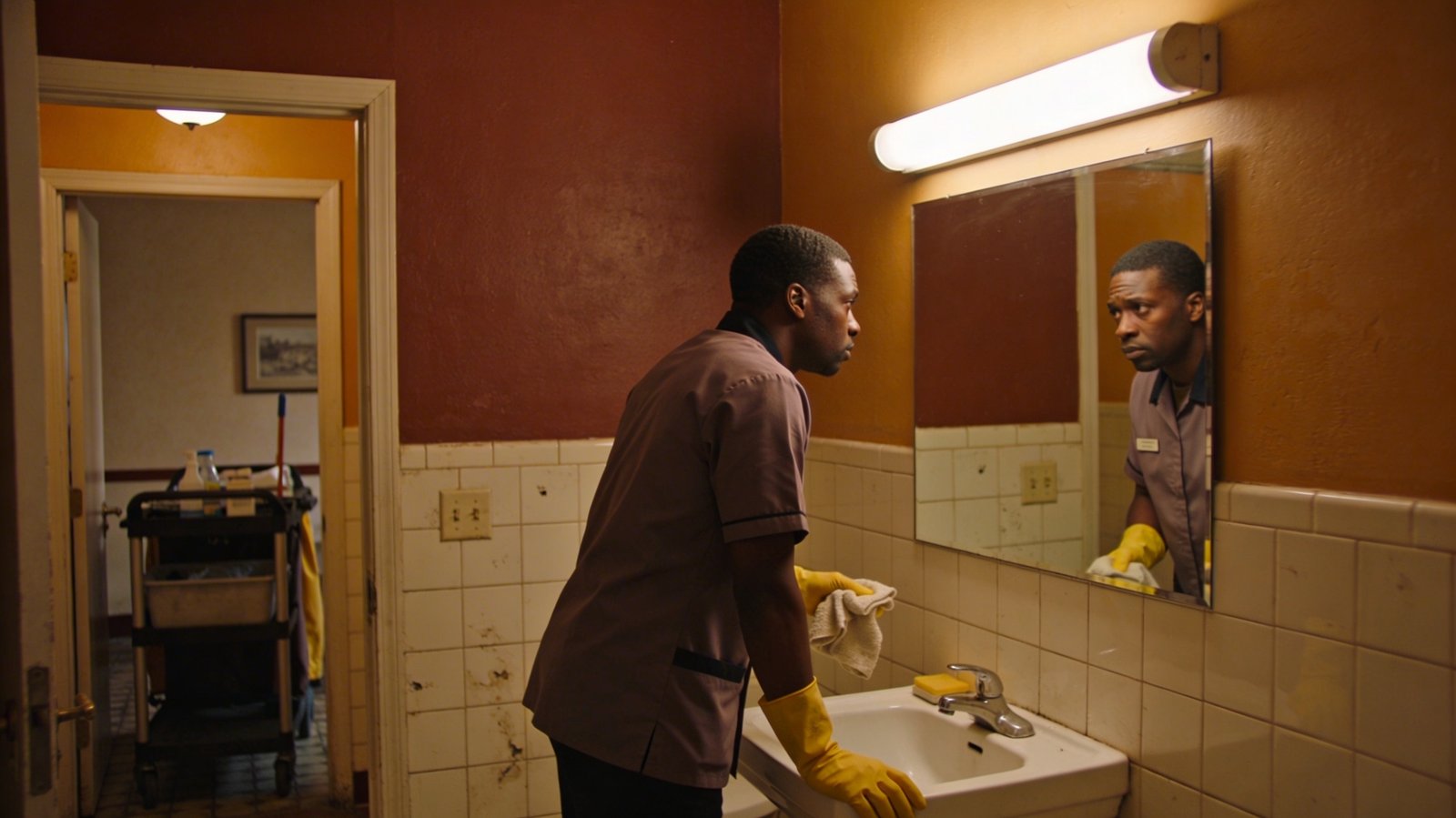
My mother believes I work in an office. I need you to understand the weight of that sentence before we proceed. My mother — a woman who sold groundnuts outside the Federal Secretariat for nineteen years so that her firstborn could “become somebody” — believes that her son sits behind a desk in a Canadian company, wears a lanyard with his name on it, and attends meetings where people say things like “let’s circle back” and “I’ll loop you in.” She believes this because I told her. And I told her because telling her the truth would have been the kind of cruelty that doesn’t leave bruises but breaks bones.
The truth is that for the first eleven months of my life in Canada, I cleaned toilets. Not metaphorically. Not “I did humble work” in the way motivational speakers say it before revealing they now own three properties and a Tesla. I mean I cleaned toilets. In a hotel near the airport. The kind of hotel where the carpets have seen things and the checkout process smells like regret and Lysol. I cleaned rooms. I emptied bins. I scrubbed bathtubs that had hosted activities I refuse to reconstruct in my imagination.
My mother believed in an office. I was surviving in a hotel.
Back Home
Back in Abuja, I was a project coordinator. I had business cards. I had a corner of a shared desk that felt, on good days, like a corner office. I had people who called me “oga” not because I had earned it but because that is what you call a man who tucks in his shirt and arrives before 8am. I was not wealthy. I was not powerful. But I was legible. People could look at me and read something.
In Canada, for those first months, I was a blank page. Worse — I was a page in a language nobody here was trying to learn. I got the cleaning job through a man I met at a Nigerian church in Scarborough. He said, “Take it. It pays. No one asks questions.” He was right on all three counts. The pay was $16.55 an hour. Nobody asked me anything — not my qualifications, not my ambitions, not my name beyond what the schedule required.
The Sunday Calls
Because my mother calls every Sunday. Every Sunday at exactly 4pm Nigerian time, my phone rings with a video call. And every Sunday, I would change out of my uniform, put on a collared shirt, sit in front of my laptop — open to a random spreadsheet I had downloaded specifically for this purpose — and tell her about “the office.” I invented colleagues. I gave them names. There was a manager called David who was “very understanding.” There was a woman in HR called Priya who had “really helped me settle in.”
I described meetings I had never attended. I complained about a printer that did not exist. I once told her the cafeteria had jollof rice on Fridays, and she was so pleased by this detail that she told her prayer group, and now an entire congregation in Wuse believes there is a Canadian office building where jollof rice is served weekly. I am going to hell for this. But at least I will arrive well-dressed.
I built an entire imaginary office so my mother could sleep at night.
Room 412
The worst day was in February. I was cleaning a room on the fourth floor — room 412, I remember because the number is now burned into my brain the way important things are — and I found a Nigerian passport on the nightstand. Not mine. A guest’s. It was open to the photo page. The man in the photo looked like he could have been my uncle. Same broad face. Same expression of cautious optimism.
I stared at it for longer than I should have, because for a moment I saw myself. Not the version of me that was holding a toilet brush in a hotel room in Scarborough. The version of me that had boarded a plane with a passport full of hope and a suitcase full of my mother’s prayers. I put the passport at the front desk. I finished my shift. I went home. And for the first time since I arrived in Canada, I cried.
Not a dignified cry. The ugly kind. The kind where your body makes sounds you did not know it could make and your nose runs faster than your pride can keep up with. I cried because I was tired of pretending. I cried because the gap between who I was and who my mother thought I was had become so wide I was not sure I could stand in both places anymore.
A Desk At Last
I found a different job four months later. Administrative assistant at a small logistics company in Mississauga. Not glamorous. Not what my degree promised. But it was a desk. It had a computer. There was no toilet brush. The first day, I took a photo of my workstation and sent it to my mother, and she replied with sixteen praying hand emojis and a voice note that was eleven minutes of thanksgiving and two minutes of asking when I was getting married.
I still have not told her about the hotel. I probably never will. Not because I am ashamed — I have made my peace with those eleven months. Every toilet I cleaned paid a bill. Every shift I survived proved something to myself that no job title ever could. I am not ashamed of the work. I am ashamed of the lie. And I carry that shame quietly, the way immigrants carry so many things — folded neatly, tucked inside, visible only to those who know where to look.
If my mother ever reads this — and she will not, because she does not know this magazine exists, and because she still has not figured out how to use the bookmark feature on her phone — I want her to know: David and Priya are not real. The jollof rice Fridays were not real. But the son who loves you enough to build an entire imaginary office so you could sleep at night? He is real. And he is sorry.
This is a Japa Confession. Names and details have been changed. The jollof rice Fridays, sadly, were fictional. If you have a confession, email stories@gathermedia.ca.