

In Lagos, church was not an event. It was a lifestyle. On my street alone, we had at least five churches: big ones, small ones, the one where the pastor shouted, the one where the choir shouted, the one that shouted in tongues only.
My Sundays were loud. Drums, generators, children running around in ‘Sunday best’ that was clearly itching them. My mother’s Bible was full of folded offering envelopes and old bulletins.
When I moved to Canada, the first Sunday felt… quiet. Too quiet.
I Googled ‘Nigerian church near me’ and went to the first one I found. It was in a rented hall. Same familiar songs, same ‘Praise the Lord!’ ‘Hallelujah!’ call and response. Honestly, it felt like someone had cut out a piece of home and pasted it into the snow.
But as the months passed, my relationship with faith started to change.
Back home, faith was community. You didn’t have to think too deeply; you just followed the rhythm. Here, it became question.
Like: If God is everywhere, why does He feel different in this small cold apartment than He did in our big hot compound?
Or: If God is my provider, why am I still negotiating with the landlord about late rent?
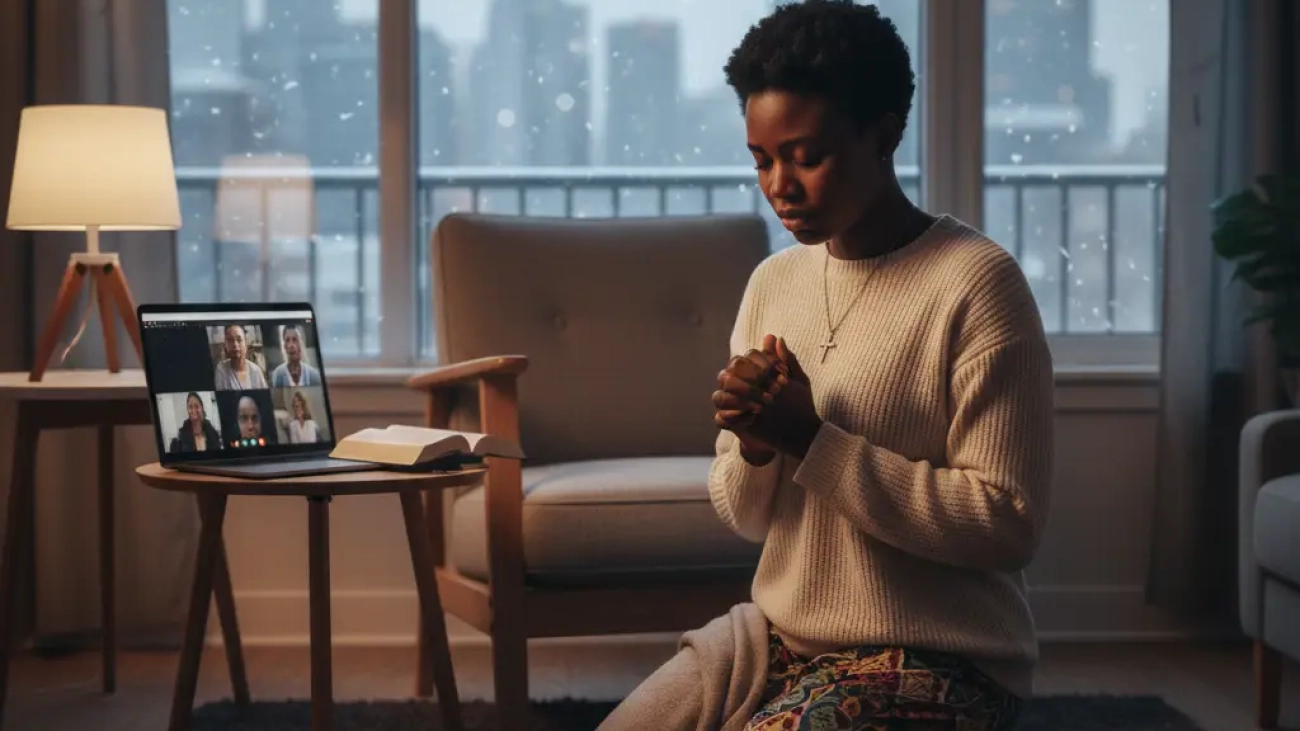
One Wednesday, after another long day of job applications and rejection emails, I didn’t have the strength to join midweek service on Zoom. I sat on my couch in silence. No worship music. No prayer points. Just me and my confusion.
I remember saying out loud: ‘God, if You followed me here, I need You to prove it. Because right now, it feels like I came alone.’
That was the first honest prayer I prayed in this country.
Slowly, my faith started to travel with me in quieter ways.
Instead of three-hour services, I had five-minute check-ins while waiting for the bus. Instead of loud altar calls, I had whispered, ‘Help me,’ before job interviews. I started journaling — not testimonies, not declarations — just raw feelings.
I also found a small multicultural church. Not Nigerian. Not loud. The pastor preached with slides. They finished on time. At first, I hated it. It felt too… organized. Where is the fire? Where is the shouting?
But one Sunday, the pastor said, ‘Sometimes faith is not a feeling you carry. It’s a decision you renew.’
That line broke something open in me.
Back home, faith was easy when everything else was familiar. Here, faith became a daily choice — in the loneliness, the winter, the uncertainty. I had to decide: Do I still believe God is good even if my life is not Instagram-ready yet?
Now, my spiritual life looks different, but it’s real.
I still join Nigerian church on Zoom some Sundays. I still miss the drums. But some weeks, my ‘church’ is a phone call with my friend in Edmonton where we confess our fears and remind each other, ‘You haven’t failed just because it’s hard.’
I have a small corner in my room — a chair, a blanket, a notebook, a candle from Dollarama pretending to be fancy. That is my altar. I sit there before the children wake up, and I talk to God in plain language.
No performance. No pretending.
If you ask me today, ‘Did your faith survive immigration?’ I will say: No. It didn’t. The version I brought here died.
But something better is growing in its place — smaller, quieter, less afraid of questions.
Faith used to mean: ‘God will fix everything if I behave.’
Now it means: ‘God will not abandon me, even when nothing is fixed yet.’
And somehow, that travels well.
Add a Comment